





.png)








Making a cash flow forecast: steps, example and the pitfalls
Whether it fits in January, you can already know in October. If you calculate it. Here is how to make a cash flow forecast, with a six month example and the mistakes that make it useless.
The third week of the month. The payroll run is ready, the quarterly VAT payment is due next week and your biggest customer still hasn't paid last month's invoice. You open the banking app and try to work out in your head whether it all fits.
Usually it fits. Sometimes it just doesn't, and you only notice when it's too late to move anything around. A cash flow forecast takes that mental arithmetic out of your head. In this article you'll read how to make one, with a completed six-month example, where it almost always goes wrong and how to have it come from your accounts instead of from Excel.
What a cash flow forecast is, and what it isn't
A cash flow forecast is an overview of what comes in and what goes out over the coming months, with the balance left over each month. It's about money in the bank, not about profit. Your profit and loss account tells you whether you're making a profit; your cash flow forecast tells you whether you can pay the VAT at the end of January.
That exact difference is what makes it necessary. A profitable company can still drop below zero in a bad month, for example because a large customer pays late while the wages simply keep running.
Don't confuse it with a cash flow budget either. You make that once a year, as a plan. You keep updating the forecast based on what's actually outstanding now, a look ahead of a few months that you refresh regularly.
Make it in five steps
1. Start with today's balance. Add up your bank accounts, including the savings account. A G-account only counts towards the VAT and payroll tax you're allowed to pay from it. That's your opening balance for the first month.
2. Set out the receipts per month. Start with what you already know: the outstanding sales invoices, in the month you expect them to be paid. Calculate with your actual payment term, not with the term on the invoice. If your customers pay after 41 days on average, then an invoice from late October falls in December. Then add the revenue you still have to invoice.
3. Set out the expenses per month. Outstanding purchase invoices on their due date, the wages, the fixed costs such as rent, insurance and software, and the loan repayments. Don't forget the taxes: the quarterly VAT, the monthly payroll tax and the provisional corporation tax assessment.
4. Add the one-off items. An investment, the holiday allowance in May, a dividend payment. These items in particular make or break a forecast, because you won't find them in last year's monthly figures.
5. Roll the balance forward. Opening balance plus receipts minus expenses is the closing balance, and that's the opening balance for the next month. Add a lower limit, the amount you don't want to go below, and see in which month you hit it.
A completed example
A wholesaler with an opening balance of 68,200 euros, the coming six months, fictional figures. The VAT runs per quarter: at the end of October for the third quarter, at the end of January for the fourth.
| Amounts in euros | oct | nov | dec | jan | feb | mar |
|---|---|---|---|---|---|---|
| Opening balance | 68.200 | 52.200 | 54.200 | 50.200 | 28.200 | 31.200 |
| Receipts from customers | 82.000 | 78.000 | 70.000 | 74.000 | 80.000 | 84.000 |
| Purchasing and suppliers | 38.000 | 36.000 | 34.000 | 35.000 | 37.000 | 39.000 |
| Wages and payroll tax | 31.000 | 31.000 | 31.000 | 31.000 | 31.000 | 31.000 |
| Fixed costs | 6.500 | 6.500 | 6.500 | 6.500 | 6.500 | 6.500 |
| VAT payment | 20.000 | 0 | 0 | 21.000 | 0 | 0 |
| Loan repayment | 2.500 | 2.500 | 2.500 | 2.500 | 2.500 | 2.500 |
| Net change | -16.000 | +2.000 | -4.000 | -22.000 | +3.000 | +5.000 |
| Closing balance | 52.200 | 54.200 | 50.200 | 28.200 | 31.200 | 36.200 |
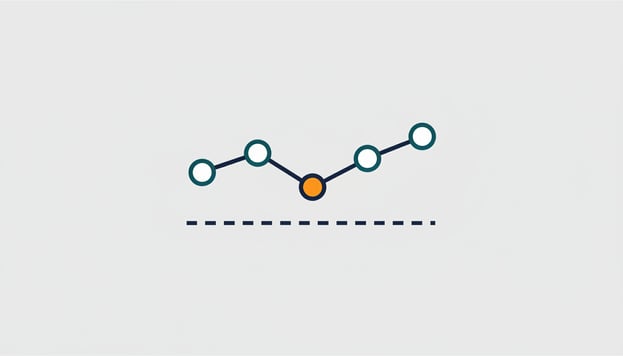
October and January are both VAT months, but they end very differently. October absorbs the payment. In January it coincides with a slower December, and the balance drops to 28,200 euros.
If you keep a lower limit of 30,000 euros, then you already know in October that January will be tight. And there is still time: shift a payment, have a customer pay earlier or arrange the credit facility in advance. That is the value of a forecast: not the figure itself, but the months of lead time.
Where it almost always goes wrong
Projecting a good month. In September three large invoices came in at once. If you take that month as the basis for the next six, you are counting yourself rich. Look at a longer period and remove the outliers.
Forgetting the taxes. VAT is not a cost, so you will not see it in your monthly figures. Payroll tax is part of your wage costs, but you pay it a month later. Both belong in your forecast, at the moment you pay them. The example above shows what a single quarterly payment does to a balance.
Confusing profit and money. Depreciation costs no money, an investment does. Revenue only becomes money once the invoice is paid. And stock you purchase is money that is gone, even while it still sits in the warehouse. A forecast works with payments, not with entries.
Making it only once. The October forecast is already out of date in December, because invoices have been sent, payments made and orders placed since then. A forecast you do not update drifts further and further from reality. That is why so many Excel forecasts end up in a drawer after three months.
Pull it from your administration instead of from Excel
Everything you fill in across the five steps is already in your bookkeeping: the bank balance, the outstanding invoices with their due dates, the payment behaviour of your customers and the fixed costs of recent months. With Exact AI Connect, or the variant for AFAS and Twinfield, Claude turns that into a liquidity forecast as a dashboard.
The dashboard starts from your current balance and your outstanding items. It then projects six months ahead at the level of the last six full months, without extending that one outlier. With sliders for revenue growth, costs, payment terms and investments you can work through your own scenarios.
The biggest difference with Excel lies in step five: updating. Every time you open the dashboard, the figures of that moment are in it. What it does not do is fill in a budget for you. It calculates with what is in your records and with the assumptions you set yourself, and those assumptions appear in an expandable section next to the calculation model.
How you request and save such an overview yourself is set out step by step in Creating dashboards in Claude. The other overviews, such as the checklist for your month-end close, can be found with the financial dashboards.
We believe a forecast is only worth something if you still open it in month three. That is why the figures should come from the records, and not from a file that someone has to maintain.
Work it out for yourself. Start 30 days free →
Try these questions in your own AI assistant
- "Create a liquidity forecast for the coming six months based on my bank balance, outstanding invoices and fixed costs."
- "In which month does my balance drop below 30,000 euros, and why?"
- "What happens to the forecast if my customers pay ten days later?"
- "Which outstanding sales invoices are likely to come in only after the due date, given the payment behaviour of those customers?"
Benefits and points to consider
Benefits of a forecast from your records: it is always up to date, it calculates with the actual payment behaviour of your customers instead of the term on the invoice, and you see a tight month coming while you can still do something about it.
Points to consider: the forecast is only as good as what is in your records, so a bank that is a week behind or invoices that have not yet been entered will show up in the outcome. One-off items that are not recorded anywhere yet, such as a planned investment, you add yourself with the sliders. And the dashboard requires the Analytics subscription plus a paid Claude subscription, because that is where it runs. On Essentials you can still ask questions about your records and get the answer in the conversation, without a dashboard.
Frequently asked questions
For day to day management, three to six months is enough. After that the uncertainty becomes greater than the forecast is worth. When applying for financing, a bank usually asks for twelve months. In that case, make the first six months detailed and the second six in broad terms.
The budget is the plan for the year, the forecast is the updated expectation based on what is currently outstanding. In practice you place them side by side. If the forecast deviates from the budget, you know where to make adjustments.
Yes. The forecast only needs your balance, your outstanding items and your history. A budget is an extra comparison, not a requirement.
Yes. Calculate your receipts and expenses including VAT, and enter the payment as a separate expense in the month you pay it. With a quarterly return, that is at the latest the final day of the month after the quarter, so the end of January, April, July and October.
At least every month, after the bank has been updated. If the forecast comes out of your administration as a dashboard, you do not have to update anything. You open it and the figures are current.