






.png)








Why your sales team and accounting have different customer data
Sales sees different customer data than finance. Addresses are wrong, VAT numbers are missing, invoices go to the wrong address. Does this sound familiar?
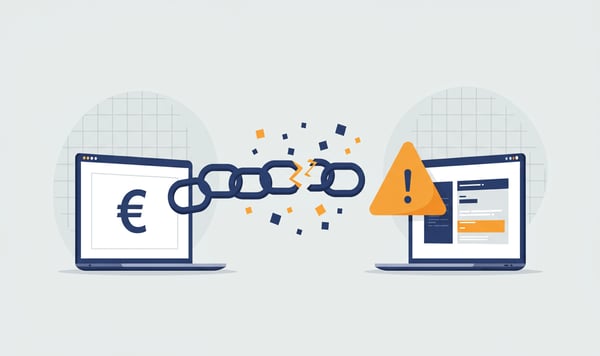
Almost a quarter of all customer records in business systems contain errors. Wrong addresses, missing VAT numbers or outdated contacts. The synchronisation problem between CRM and accounting is not in the data itself, but in the fact that two departments keep the same customer data in two systems, without those systems talking to each other.
The same customer, two versions of the truth
Your sales team works in HubSpot, Salesforce or Pipedrive. They record prospects there, update deals and note contact details. Meanwhile finance works in Exact Online. Invoices, payments and accounts receivable management, all based on relations created there.
The problem starts small. Accountants BV moves and passes the new address on to your account manager. That person updates it in HubSpot. But Exact Online still shows the old address. The next invoice goes to a building where your customer no longer sits.
Or the other way around. Finance corrects the company name from "Accountants BV" to "Accountants B.V." with a period because the Trade Register lists it that way. Sales knows nothing about it. Now you have two records with slightly different names for the same customer.
"I already paid" and nobody can check it
This is a scenario almost every company recognises. A customer calls your sales department and says: "That invoice was paid last week." Your account manager opens the CRM. There are deals, notes and call reports. But payment status? That sits in Exact Online. And sales has no access to it.
The result: your account manager says "Let me check with finance" and sends an internal email. Finance looks it up and emails back. The customer waits. Sometimes an hour, sometimes a day.
Meanwhile that customer does not feel taken seriously. Because in their view this is simple information your company should already know.
The contact who left
Another classic problem. Your contact at a customer leaves. The customer might let finance know by email with the next invoice. Or sales hears about it through LinkedIn. But the information rarely reaches both systems.
The result: a quote sent to someone who no longer works there. Or a reminder invoice to a person who left months ago. It is not only inefficient, it also comes across as unprofessional.
Where it goes wrong technically
The CRM systems most Dutch companies use, such as HubSpot, Salesforce and Pipedrive, each have their own data structure for customer details.
HubSpot organises customer data around Contacts and Companies. Salesforce works with Accounts and Contacts. Pipedrive with Persons and Organizations. Each system has its own fields, its own validation rules and its own ways of creating relations.
Exact Online has yet another model: CRM/Accounts as the central relations table, with fields such as debtor number, VAT number, Chamber of Commerce number and payment terms. Information that often does not even exist in your CRM.
Without a connector these are separate worlds. An address change in HubSpot never reaches Exact Online. A new debtor number in Exact Online is invisible in Pipedrive. And a VAT number that finance adds? Salesforce knows nothing about it.
The figures: what does this cost?
Research shows that about 23% of customer records in business systems contain errors. That sounds abstract until you translate it to your daily work.
A faulty invoice with incorrect company details takes an average of 30 to 60 minutes to correct. You have to track down the error, credit the invoice, create a new one and inform the customer.
With ten of these errors per month you are looking at 5 to 10 hours of extra work. Purely to straighten out data that was already correct in another system.
And that is only the direct time spent. The indirect costs, such as delayed payments due to invoices that never arrive, customers who drop out because of unprofessional communication or sales conversations that stall because payment information is missing, are harder to measure but often larger.
The real problem is not the data
It is tempting to see this as a data problem. But it is not. The data does exist, just in the wrong place. Your sales team has the right phone number. Finance has the right VAT number. The problem is that this information does not flow.
Manual synchronisation does not work. Everyone who has tried it has found that out by now. A monthly Excel export from HubSpot to Exact? After two months nobody does it anymore. A shared spreadsheet where both teams track changes? After a week there are already conflicts.
What does work is a direct connector between your CRM and your accounting. One that passes on changes automatically, in both directions. So that an address change in HubSpot is immediately visible in Exact Online. And a payment status in Exact Online automatically flows back to your CRM.
Whichever CRM you use
The solution differs per CRM, but the principle is the same.
With HubSpot, a connector syncs your Companies and Contacts to Exact Online relations, including address details, VAT numbers and payment terms. Deals automatically become orders or invoices. And payment statuses flow back, so your sales team can see in HubSpot whether a customer has paid. You can read more about this in our article on the HubSpot Exact Online connector.
With Salesforce it works in a similar way. Accounts and Contacts are synchronised, Opportunities become orders, and payment status flows back to Salesforce. With Agentforce and Data 360 the dataset becomes even richer, but without a connector to your accounting a gap remains. Read more about the Salesforce Exact Online connector.
And with Pipedrive, popular among SME sales teams, a connector synchronises Organizations and Persons with Exact Online relations. Deals become invoices, and the payment status is visible in Pipedrive via the timeline. See the details in our article on the Pipedrive Exact Online integration.
One customer, one truth
The goal is simple. No matter where you look, CRM or accounting, you see the same customer data. The same address, the same VAT number, the same contact person. No more "let me just check with finance". No more invoices to the wrong addresses. No more quotes to people who no longer work there.
The technology is here. The connectors exist. The only thing left is to take the step.
Do you want to try it yourself? View the HubSpot connector →