





.png)








Customer data across 5 different systems: do you recognise this chaotic scenario?
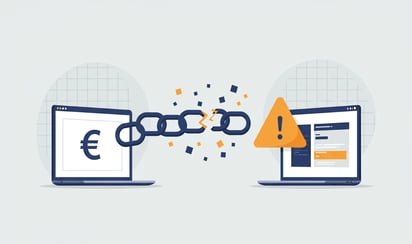
Your sales manager promises a 5% discount. Finance knows nothing about it and sends an invoice without the discount. Sound familiar? Here is how to fix data silos.
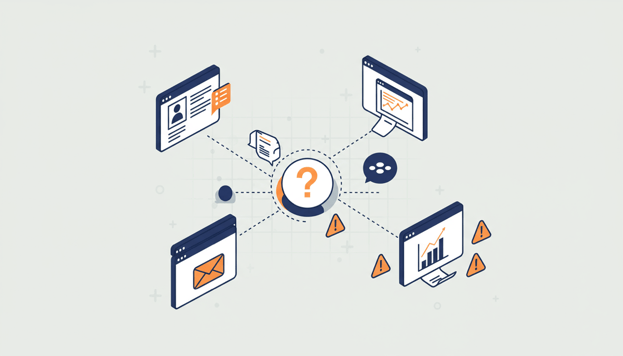
Your sales manager calls a client. Promises a 5% discount to close the deal. Notes it in HubSpot, sends an internal Slack message. Two weeks later finance sends the invoice from Exact Online, without the discount. The client calls. Not happy.
This is not a hypothetical scenario. It happens every day at growing companies where customer data is scattered across multiple systems. Centralising customer data is therefore not just an IT project. It is the foundation for working professionally. Read more about HubSpot integration options.
Five systems, zero overview
An average SME works with five to eight different systems. CRM for sales, Exact Online for the bookkeeping, an email tool for marketing, spreadsheets for reports and invoicing software for quotes. Each system has its own version of the truth.
The sales department sees a client as a "warm lead with a 5% discount agreed". Finance sees the same client as a "debtor, standard payment terms". Customer service sees something else again, a ticket history without context about ongoing deals or outstanding invoices.
Nobody has the complete picture. And you only notice when things go wrong.
Why it gets worse as you grow
With five clients you can remember everything. With fifty it becomes difficult. With five hundred it is impossible.
Growth amplifies every problem with scattered data. More employees means more systems, more manual entry and more chances for mistakes. A new sales employee does not know the agreements a colleague made last year. A finance employee processes a credit note without knowing there is a dispute in progress.
The figures confirm this. Dutch SMEs are embracing technology at a record pace, AI adoption for example rose from 9% in 2024 to 41% in 2025. But 58% say the implementation is difficult. Not because the technology does not work, but because the underlying data is not in order.
AI on messy data delivers messy results. That applies to your bookkeeping, your CRM and everything in between.
The real cost of data silos
The direct costs are visible. Double entry takes time. An employee who has to update customer details in both the CRM and the bookkeeping spends at least an hour a day on it. That is more than 200 hours a year per employee.
The indirect costs are bigger but less visible:
Incorrect invoices: Price agreements that do not make it from sales to finance are one of the most common complaints. An invoice with the wrong amount damages the trust your sales team carefully built up.
Missed payments: If your CRM does not know which invoices are outstanding, sales cheerfully calls a client who has not paid for three months. Or worse, you give a discount to a client with an overdue payment, because that information sits in another system.
Poor decisions: Your quarterly report combines data from three sources. The sales spreadsheet says revenue is rising. Exact Online shows that margins are falling. Which story is correct? Without a shared truth you only find out when it is too late.
The global market for integration solutions is heading toward 33 billion dollars in 2030 for good reason. Companies are realizing on a large scale that separate systems cost more than they deliver.
The recurring discount problem
Back to that 5% discount. The problem is not with the sales manager who forgets to pass it on. It is not with finance who sends the invoice without thinking. It is the fact that a manual handover is needed at all.
In a connected system it works differently. Sales closes a deal in HubSpot or Salesforce with the agreed discount. That deal flows automatically to Exact Online as a sales order, including the discount. Finance does not have to retype anything. The invoice is simply correct.
No Slack messages that get lost. No spreadsheets that never get updated. No angry customers.
When is it time to connect your systems?
Not every company needs a fully integrated system on day one. But there are signals that indicate the moment has come:
- Your team spends time on a structural basis transferring data between systems
- Customers report errors in invoices or quotes that can be traced back to miscommunication
- Your management asks for reports that combine data from multiple sources and nobody trusts the figures
- New employees need weeks to understand which system takes the lead
Do you recognize two or more of these? Then centralizing customer data is not something for "later". It is something for now.
What a connector looks like in practice
A connector between your CRM and Exact Online does not have to be a big IT project. At iWebDevelopment, an official Exact Online partner with ISO 27001 certification, we set up connectors that run within a day.
The core is simple: customer and contact details flow from your CRM to Exact Online. Deals automatically become sales orders or invoices. Payment statuses go back to your CRM, so sales always knows whether a customer has paid.
Curious how that works with your CRM? Read more about the HubSpot-Exact Online connector, the Salesforce-Exact Online connector or the Pipedrive-Exact Online connector.
Want to try it yourself? View the HubSpot connector →