E-invoicing towards 2030: what it means for your purchasing
Most articles about e-invoicing deal with sending. This one is about receiving: what will come in as purchase invoices over the coming years, and why a PDF will not disappear before 2030.
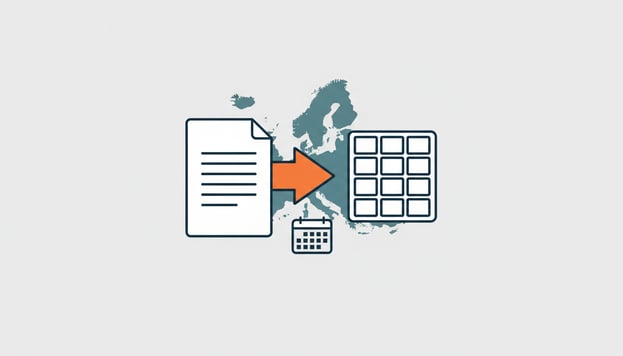
In January 2026 a research report commissioned by three ministries recommended making e-invoicing mandatory for all Dutch B2B transactions, with Peppol as the infrastructure and 1 January 2030 as the start date. In March that report went to the House of Representatives, and an internet consultation of the draft law is planned for the fourth quarter of 2026. Almost everything written about it concerns sending: how do you create an e-invoice, which software can handle Peppol. This article is about the other side, the invoices that arrive at your desk, because that is where the change comes first and most strongly.
Where the Netherlands stands
The timeline as it currently stands:
- 23 January 2026: report on ViDA, e-invoicing and digital reporting, with the recommendation to make domestic B2B invoices electronic by law.
- March 2026: the report goes to the House; the cabinet announces a position before the summer.
- Fourth quarter 2026: internet consultation of the draft law.
- Mid 2028: intended law.
- 1 January 2030: mandatory e-invoicing for domestic B2B transactions; 1 July 2030 for intra-community transactions, which coincides with the European reporting obligation from ViDA.
- 2032: digital reporting to the Tax Authority.
That is a proposal, not a law. But the direction is fixed at European level: since April 2025 member states may require e-invoicing without permission from Brussels, and from 1 July 2030 a digital reporting obligation for cross-border B2B transactions applies across the entire EU.
The neighbouring countries are ahead
Anyone doing business with Belgium or Germany notices it already.
Belgium has required structured e-invoices via Peppol between VAT-liable companies since 1 January 2026. A pdf by email no longer counts there as a B2B invoice, and the fines run from 1,500 euros for a first offence to 5,000 euros. A Dutch supplier is formally not subject to that obligation, but in practice a Belgian customer asks for a Peppol invoice, and a Belgian supplier sends one.
Germany has had a receipt obligation since 2025: every German company must be able to receive an e-invoice. From 1 January 2027 German companies with a turnover of 800,000 euros or more must also issue them, and from 2028 this applies to everyone.
The result for your purchasing: the share of structured invoices (UBL, Peppol BIS) in your inbox is already growing, years before the Netherlands requires anything.
What changes about the invoices that arrive
A structured invoice is an XML file with fixed fields: supplier, VAT number, invoice number, lines, VAT per line, totals. What it saves you is the reading. What it does not save is the assessing, and that is where most of the time goes:
- Duplicate or not. An e-invoice can just as easily arrive twice as a pdf, for example if the supplier also sends it by email. The check on supplier plus invoice number remains necessary.
- Is the IBAN still the same? A structured file contains an IBAN field, and that field can just as easily have been changed as the IBAN on a pdf. Comparing it with what you saw earlier from this supplier remains the most important fraud check.
- Which general ledger account and which cost centre? The invoice says nothing about that. Coding remains work, and it is work that only disappears once something learns the patterns of your administration.
- Which VAT code? A reverse-charge invoice from Germany arrives with 0 percent VAT. Which code that is in Exact Online, and whether the supplier's VAT number is valid, still has to be determined.
In short, e-invoicing moves the work from reading to checking and coding. Anyone who does that by hand saves half a minute per invoice. Anyone who automates it saves the other four.
Why the pdf will not disappear before 2030
Three groups of suppliers will keep sending pdf's, even when the large parties switched over long ago:
- Small Dutch suppliers who see no reason to change anything until the obligation kicks in. There are many of those until 2030.
- Suppliers outside the EU. A licence from the United States or a service from the United Kingdom arrives as a pdf, and a Dutch law does not change that.
- Receipts and expense claims. A fuel receipt, a train ticket, a hotel bill: no Peppol.
A purchasing process that can only handle e-invoices is therefore a process with a second track alongside it for the coming years. The goal is one track: pdf and UBL arrive in the same place, go through the same checks and end up as the same booking proposal.
What you set up now
Four things you can do today, in order of return:
- Make sure you can receive e-invoices. Exact Online has included Peppol in all versions since 1 January 2025. Register your Peppol address and pass it on to suppliers who ask for it.
- Choose one intake point for all purchase invoices. One email address per administration where suppliers, colleagues and forwarded invoices go, regardless of whether it is a pdf or a UBL file.
- Make the checks identical for both formats. Duplicate, IBAN change, VAT number, sum check: an e-invoice deserves the same check as a pdf.
- Record how you code. A fixed general ledger account and cost centre per supplier, so that a new file format does not affect the coding.
The Purchase Invoices module for Exact AI Connect is built exactly like this: one mailbox per administration, pdf's are read by AI, UBL 2.1 and Peppol BIS are processed directly, and both formats go through the same checks and the same coding. The transition to 2030 is therefore not a transition for that module: the share of UBL grows, the working method stays the same.
Ready to get started? Start your free trial →
Try these questions in your own AI assistant
- "Which part of my purchase invoices from the past three months came in as UBL and which part as pdf?"
- "Which suppliers in my administration are based in Belgium or Germany?"
- "Show the purchase invoices of this month for which the supplier's VAT number has not yet been checked."
Benefits and points of attention
Benefits of e-invoicing for the purchasing side: no reading errors, all fields present, faster processing. And if the checks are already automated, a UBL invoice takes even less time than a pdf.
Points of attention: the Dutch timeline is a proposal and may shift, so check the current status before you set internal deadlines. And e-invoicing says nothing about the correctness of an invoice. The checks on duplicates, IBAN and VAT remain just as necessary.
Frequently asked questions
According to the proposal currently on the table, from 1 January 2030 for domestic B2B invoices and from 1 July 2030 for intra-community invoices. The internet consultation of the draft law is planned for the fourth quarter of 2026, with the law itself expected around mid-2028. It is not yet law.
Formally no, but in practice yes if you have suppliers in Belgium (mandatory since 2026) or Germany (large companies from 2027). Exact Online supports Peppol in all versions.
Not entirely. Suppliers outside the EU, receipts and expense claims will keep arriving as PDFs. A purchasing process needs to handle both forms.
UBL is the file format (XML with fixed fields); Peppol is the network over which such files are securely exchanged, with its own profile (Peppol BIS) based on UBL.
It does. An e-invoice can arrive twice, contain a changed IBAN or carry an invalid VAT number. What disappears is the reading, not the assessment and coding.