






.png)








Why your webshop and bookkeeping don't show the same stock
Monday morning, 09:12. A customer calls. She ordered a garden set on Friday evening, paid for it and already put the old chairs out with the bulk waste. But the message she just received says: out of stock. You check Exact Online: zero in stock. Your webshop still showed three.
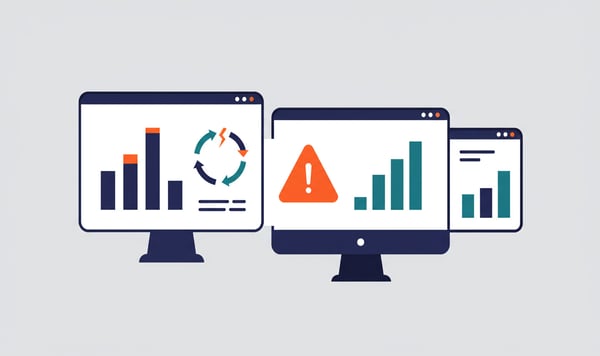
"Sorry, this product isn't available after all"
Monday morning, 09:12. A customer calls. She ordered a garden set on Friday evening, paid for it, and already put her old chairs out with the bulk waste. But the message she just received says: out of stock. You check Exact Online: zero units. Your webshop still showed three. Those three had already sold on Friday afternoon through Bol.com, but you hadn't processed that change yet.
Now you have an angry customer, a refund, and a one-star review that hits your reputation. Not because your product is bad. But because two systems told a different story about your stock.
This is what overselling does. And it happens more often than you think.
How stock differences arise
Stock synchronisation problems rarely come out of nowhere. They have three recognisable causes, and these reinforce each other.
Time delay between systems
Your webshop and your accounting live in separate worlds. A sale in WooCommerce only becomes visible in Exact Online when someone enters it manually. Or when an import runs, sometimes just once a day, sometimes even just once a week.
In the meantime your webshop keeps selling based on outdated numbers. The same item can be shown as "in stock" through Shopify, Bol.com and Amazon at the same time while only two units remain in your warehouse. Three orders later you have disappointed three customers.
Manual entry
Every time someone manually types in a stock change, a receipt, a correction, a transfer between warehouses, there is a chance of errors. Automated systems reach an accuracy of 99.96% to 99.99%. With manual entry the error rate lies between 1% and 5%, according to research from DocuClipper.
That sounds small. But with a range of 500 items and regular changes you are quickly looking at dozens of stock errors per month. Errors that only stand out when a customer orders something that isn't there.
Returns as a blind spot
Returns are the silent saboteur of your stock management. A customer sends a product back. The package arrives, is checked, and must be put back into stock in your warehouse, in Exact Online, and across all your sales channels.
In practice that takes time. Sometimes hours, sometimes days. The item isn't for sale while it is actually available, causing you to miss out on revenue. Or worse: the return is processed in one system but not in the other, causing the numbers to fall out of sync.
What overselling really costs you
The consequences of stock differences go beyond a cancelled order. Worldwide, stockouts and overselling cost businesses $1 trillion per year, calculated Strabo Partners. That is an astronomical number, but it adds up on the scale of a single webshop too.
Direct costs per incident
Every oversell costs you €6 to €10 in direct costs. Think of the time for customer service, processing the refund, the transaction costs you don't get back, and any shipping costs for a replacement product.
At five oversells per week, which is not unusual for a webshop with multiple sales channels, you lose €120 to €200 per month. Purely on damage control.
Cancellations and refunds
75% of customers who are told that an ordered product is no longer available cancel the order and request a refund. They do not order an alternative. They leave.
That is revenue you already had. Revenue that was in your reports. Revenue you now have to reverse, along with all the administrative hassle that comes with it.
Customers who never come back
This is the hidden damage. After an oversell experience, about 15% of customers make no repeat purchase. They simply do not return. No complaint, no review, they quietly disappear from your customer base.
With an average customer value of €150 per year and ten oversell incidents per month, you potentially lose €2,700 in annual repeat revenue. Every month the problem continues, that amount grows.
More channels, bigger chaos
Do you only sell through your own webshop? Then the problem is manageable. Do you also sell through Bol.com, Amazon or a physical store? Then the risks multiply.
Each channel has its own stock registration. A sale on Bol.com should not only be processed in Exact Online, but also adjust the stock in your Shopify shop. And in your Amazon listing. And the other way around.
Without central stock synchronisation, it is a matter of time. Not whether something goes wrong, but when and how often.
The solution lies in the frequency
The core problem is not that your systems are wrong. The problem is that they do not talk to each other fast enough.
A daily export does not solve stock synchronisation problems. Even an hourly export is insufficient during busy sales periods. What you need is a connector that synchronises every five minutes, in both directions.
A sale in your webshop? Stock in Exact Online is automatically reduced. Goods receipt booked in Exact Online? Your webshop shows the correct quantities within minutes. Return processed? All channels are updated.
That is the difference between 1-5% errors with manual entry and the 99.96%+ accuracy of automated synchronisation. Not slightly better, but a completely different order of magnitude.
What this means for your webshop
Stock discrepancies are not an administrative inconvenience. They cost you customers, revenue and reputation. And the problem grows as you grow faster and process more orders, through more channels, with far more moments when stock discrepancies can occur. With all the consequences that entails.
The technology to solve this exists. A connector between your webshop and Exact Online that continuously synchronises stock, orders and products. No manual typing, no outdated quantities, no angry customers on Monday morning.
The difference between a webshop that treats oversells as "part of the deal" and a webshop that structurally prevents them? Five minutes. That is how long a synchronisation cycle takes. That is all it takes to eliminate the problem.
Do you want to prevent stock discrepancies? View our webshop connectors →
Frequently asked questions
Usually because of a time delay. Sales, returns and receipts are only processed later, either manually or through a daily import. In the meantime your webshop keeps selling based on outdated numbers. Manual entry adds another 1 to 5 percent in errors on top of that, so the differences keep piling up.
More than you might think. Every oversell quickly costs 6 to 10 euros in direct expenses for customer service, refunds and transaction fees. On top of that, 75 percent of customers cancel their entire order when a product turns out to be unavailable, and about 15 percent never come back after an experience like that.
A daily export is not enough, and even hourly falls short during busy sales periods. With a connector that synchronises in both directions every five minutes, sales, returns and goods receipts are updated almost instantly in both your webshop and Exact Online.
Yes. Every extra channel has its own stock registration, so a sale on one channel also has to be updated in your bookkeeping and all other channels. Without central synchronisation, it is not a question of whether things go wrong, but when and how often.
No, returns are actually a blind spot. Between the moment a parcel arrives and the moment the item is sellable again, there are often hours or even days. If a return is processed in one system but not in the other, the numbers stay out of sync.