






.png)








Connecting Salesforce to Exact Online: possibilities and points of attention
Salesforce Agentforce makes real-time ERP data more important than ever. Compare your options to connect Salesforce to Exact Online.
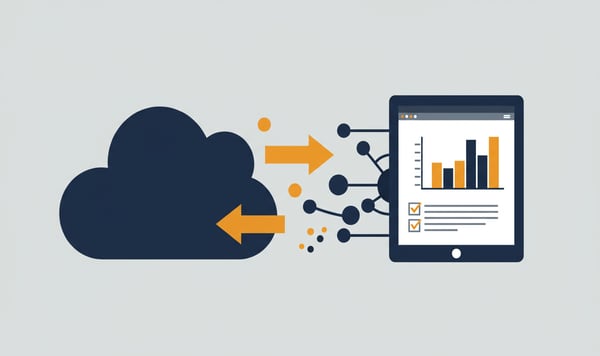
Salesforce launched Agentforce 360 at the end of 2025, a platform where autonomous AI agents qualify leads, route cases and follow up on opportunities without human intervention. The "Data 360" layer that Salesforce builds beneath it aggregates customer data in real time across all clouds. These agents make decisions on their own and need current financial data to do so. Not tomorrow, but now. If your Salesforce Exact Online connector is outdated or manual, those agents miss crucial information: outstanding invoices, payment history, credit limits.
That makes the question of how to connect Salesforce and Exact Online more relevant than ever. In this article we compare four ways to build that connector, including the pros and cons of each approach.
What exactly do you synchronise?
Before you choose a connector solution, it helps to know which data usually moves back and forth between Salesforce and Exact Online.
From Salesforce to Exact Online:
- Accounts and Contacts become relations and contact persons in Exact Online
- Opportunities become sales orders or invoices
- Products and PricebookEntries become items and price lists
From Exact Online to Salesforce:
- Invoice status: has the invoice been sent, paid or is it overdue?
- Payment information: when was payment made and how much?
- Outstanding items: what is still open per customer?
That return flow is crucial. A sales employee calling a customer who has three unpaid invoices wants to know that before the conversation starts. And Agentforce agents that make autonomous decisions about upsell opportunities? They need that data in real time.
Option 1: Orbis Software connector
Orbis Software offers a ready-made connector between Salesforce and Exact Online. It is one of the better-known solutions on the Dutch market.
Advantages:
- Proven product with specific Exact Online knowledge
- Standard field mappings for the most common objects
- Support from a Dutch company
Disadvantages:
- Limited flexibility with deviating processes
- License costs that rise as you add more users
- Adjustments beyond the standard require custom projects
- Updates depend on the Orbis release cycle
For companies with a fairly standard sales-to-invoicing process, the Orbis connector can be a solid choice. If you work with complex price structures, multi-currency or custom Salesforce objects, you will hit limits sooner.
Option 2: Zapier or Make (no-code)
Platforms such as Zapier and Make let you build connectors between hundreds of applications, including Salesforce and Exact Online, without any code.
Advantages:
- Quick to set up for simple flows
- No developer needed
- Low entry costs
Disadvantages:
- Exact Online integration is limited (few available actions)
- No support for complex logic such as multi-currency or stock movements
- At high volume the costs become unpredictable (paying per task)
- Error handling is rudimentary: if a sync fails, you sometimes only notice it days later
- No bi-directional sync without duplicate Zaps/scenarios
Zapier or Make works fine if you want to push a handful of new customers per week from Salesforce to Exact Online. But as soon as you want to sync invoice statuses back or work with more than a hundred transactions per day, you quickly reach the limits.
Option 3: Custom API integration
You can also have a fully custom integration built by a development team. Direct connectors through the Salesforce REST API and the Exact Online API.
Advantages:
- Maximum flexibility, anything is possible
- Tailored precisely to your processes
- Full control over data flow and error handling
Disadvantages:
- High initial costs (tens of thousands of euros is not unusual)
- Lead time of months
- Maintenance is entirely your responsibility
- Every API change from Salesforce or Exact Online can break the connector
- The knowledge sits with the developer, so what happens if they leave?
Custom integrations make sense for enterprise organisations with unique processes that fit nowhere else. For most companies it is overkill and a long-term risk.
Option 4: iWebDevelopment custom connector
iWebDevelopment offers a custom connector between Salesforce and Exact Online that sits between a standard connector and a fully custom solution.
Advantages:
- Configurable field mappings, no code needed for standard adjustments
- Support for multi-currency (CurrencyIsoCode to AmountFC/AmountDC)
- Bi-directional sync including invoice status and payments
- ISO 27001 certified, independently pentested
- Cancellable monthly, no contract obligations
- Official Exact Online partner
Disadvantages:
- Less well known than Orbis in the Salesforce market
- For very complex Salesforce customisations, additional consultation may be needed
The comparison at a glance
| Feature | Orbis connector | Zapier/Make | Custom API | iWebDevelopment |
|---|---|---|---|---|
| Bi-directional sync | Yes | Limited | Yes | Yes |
| Multi-currency | Limited | No | Yes | Yes |
| Cost indication | License + setup | From 20 euros/month | 10,000+ euros one-time | On request |
| Implementation time | Days to weeks | Hours | Months | Days |
| Flexibility | Standard flows | Simple flows | Unlimited | Configurable |
| Maintenance | By Orbis | Yourself | Yourself (or developer) | By iWebDevelopment |
| Agentforce-compatible | Via standard sync | No (too slow) | If built | Yes (real-time option) |
Points of attention for every Salesforce-Exact connector
No matter which option you choose, there are a few technical points you should think through beforehand.
Field mapping is less simple than it seems: Salesforce stores an address as BillingStreet, BillingCity, BillingPostalCode and BillingCountry, four separate fields. Exact Online uses a separate Addresses object with its own structure. Translating that is not always one-to-one. The same goes for contacts: Salesforce links Contacts to Accounts, Exact Online links Contactpersonen to Relaties. The hierarchy looks the same, but the ID structure differs.
Multi-currency deserves extra attention: Salesforce has a CurrencyIsoCode field on nearly every object. Exact Online works with AmountFC (invoice amount in foreign currency) and AmountDC (amount in your ledger currency). If you invoice in multiple currencies, your connector has to make that translation without errors, including exchange rates.
Sandbox versus production: Salesforce has an extensive sandbox system. Always test your connector first in a Salesforce sandbox with an Exact Online test administration. A field mapping mistake that creates a thousand invoices incorrectly is not something you want to discover in production.
Agentforce needs real-time data: If you deploy Agentforce agents that make autonomous decisions based on customer data, a nightly batch sync is not enough. Those agents expect current payment status and outstanding items. Choose a connector that supports near-real-time synchronisation, or at least several times a day.
The right choice depends on your situation
There is no universal "best" connector. A company with ten Salesforce users and a standard sales process has different needs than an enterprise with five Salesforce clouds, multi-currency and Agentforce agents.
What is universal: the connector between your CRM and accounting is becoming more important, not less. AI agents, whether they come from Salesforce, HubSpot or another party, need reliable, current financial data. The better you set up that data flow now, the more you will benefit from it later.
Do you want to dive deeper into what a custom connector looks like in practice? Then read how a Salesforce-Exact custom connector works.
Want to try it yourself? View the Salesforce connector →
Prefer a different CRM? HubSpot connector → | Pipedrive connector →
Frequently asked questions
That depends on your volume and processes. For simple flows with a few new customers per week, a no-code platform is enough, and for a standard sales process a ready-made connector can work. If you work with multi-currency, higher volumes or non-standard processes, a configurable custom connector usually offers the better balance between flexibility and maintenance.
From Salesforce to Exact Online usually go accounts, contacts, opportunities and products, which become relations, sales orders and items there. In the other direction flow invoice status, payments and outstanding items, so sales can see before a customer call whether any invoices are still open.
For a handful of new customers per week it works fine. If you want to sync invoice statuses back, process more than a hundred transactions per day or invoice in multiple currencies, you will quickly hit the limits and the cost per task becomes unpredictable.
Agentforce agents make independent decisions based on customer data and need current payment status and outstanding items to do so. A nightly batch sync is not enough then. Choose a connector that syncs near-real-time, or at least several times a day.
Salesforce and Exact Online structure data differently. In Salesforce an address sits in four separate fields, while Exact Online uses a separate address object, and the connection between contacts and companies also differs. That is why you should always test the mapping first in a Salesforce sandbox with an Exact Online test administration before going live.