





.png)








Always up-to-date insight into your cash flow: why that is not yet a reality
Cash flow is the number one concern for SME entrepreneurs. Yet most companies work with outdated banking data. Discover how an automatic bank connector changes that.
Cash flow is the most important indicator of your company's health. Not profit, not revenue, but cash flow. Yet 82 percent of SME businesses that go bankrupt have cash flow problems as the main cause. Not because they didn't earn enough, but because they saw too late that the money was running out.
Real-time insight into your cash flow could prevent that. The problem is that for most businesses that insight simply isn't there.
The paradox of fast payments and slow bookkeeping
Instant payments have been mandatory in the EU since 2025. Every payment arrives within ten seconds. At the same time, the bookkeeping of most SME businesses runs on weekly batches.
That contradiction is absurd when you think about it. The money moves in real time. Your insight into that money lags five days behind.
Why? Because the connection between bank and bookkeeping, importing bank statements, is still done manually at the majority of businesses. As long as that connection is manual, your cash flow overview can never be up to date.
What you miss without up-to-date cash flow data
Liquidity decisions based on gut feeling: You have a large invoice to pay. Do you have enough balance? You log in to the bank, check your account, and try to estimate in your head which payments are still coming. That is not financial management. That is gambling.
Delaying investments or making them too early: Without an up-to-date overview of incoming and outgoing cash flows, you make investment decisions based on outdated data. You wait too long while the money is actually there. Or you invest while a large payment has to go out next week.
Not seeing seasonal patterns coming: Cash flow has rhythms. Quarterly payments, seasonal dips, holiday periods. If your data comes in daily instead of weekly, you spot patterns weeks earlier.
The difference between bank balance and cash flow
A quick but important distinction. Your bank balance is not your cash flow.
Your bank balance is a snapshot: this much is in your account right now. Your cash flow is the movement: what comes in, what goes out, and what is the trend?
To understand cash flow you need two things:
- Up-to-date bank transactions: what came in and went out today?
- Bookkeeping context: which invoices are still open, which payments are expected?
Only when you combine bank transactions and bookkeeping data do you get real insight. And that is only possible when both sources are up to date.
How an automatic bank connector changes this
A bank connector via PSD2 retrieves your transactions automatically every day and loads them into your bookkeeping software. No manual download, no import, no delay.
The direct effect is that your bookkeeping lags at most 24 hours behind your bank instead of three to five working days. That sounds like a small difference. In practice it is the difference between a usable cash flow overview and an outdated report.
With up-to-date bank transactions in your bookkeeping you can:
- See your actual liquidity position at any moment. Not last Friday's balance, but today's figure.
- Match incoming payments directly with outstanding invoices. Your accounts receivable overview is always up to date.
- Create cashflow forecasts based on recent data. The more current your input, the more reliable your prediction.
A practical example
An installation company with eight employees and a monthly turnover of 120,000 euros. Every Monday the administrator imported the past week's bank statements. By Tuesday the cashflow overview was updated.
After setting up an automatic bank connector, the bank transactions came in daily. The effect was noticeable straight away:
- The owner now checks his cashflow dashboard every morning and sees yesterday's payments.
- Payment reminders go out faster because outstanding items are updated the moment a payment comes in.
- At the end of the month there is no longer a backlog of unprocessed statements.
The biggest difference was not in the technology but in the behaviour. Because the data was current, the owner looked at it more often. And because he looked at it more often, he stepped in sooner when something was off.
What do you need for real-time cashflow insight?
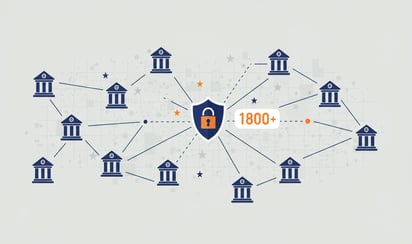
It starts with an automatic bank connector. That is the foundation. Without current bank transactions in your accounting, every cashflow overview is an estimate. Through PSD2 you connect your bank accounts directly to your accounting package, and more than 1,800 banks are supported. But the connector alone is not enough. Your accounting package has to do something with it too. Exact Online, Twinfield and AFAS all offer cashflow dashboards, and the quality of those dashboards depends entirely on how current the data going into them is. And then there is the discipline to actually look at it. That sounds trivial, but it is the crux. A cashflow overview you check once a month is a report. A cashflow overview you check daily is a management tool.
The threshold is lower than you think
An automatic bank connector costs from 7.50 euros per month and is up and running within a day. The connection is secured to banking standards and complies with the PSD2 guidelines.
You share no login details. The connector runs through your bank's official API, the same infrastructure your bank uses for its own app. Do choose a provider with ISO 27001 certification, so you can be sure your financial data is processed to the highest standards. You can read more about the security of PSD2 connectors in our article on PSD2 and security.
We believe current cashflow insight is not a luxury but a necessity. The technology is here. The costs are negligible. And the first step is simpler than most entrepreneurs expect.
Want to try it yourself? View our bank connector →